Your Next Team Member Is an AI Agent. Are You Ready to Trust It?
Introduction
The $450 billion opportunity attached to AI agents is real. So is the lack of trust holding most organizations back from capturing it. What matters to capture the value of any agentic setup is confidence in what agents will do, and how they will do it.
The Agent Era Has Arrived, but Trust Hasn't Kept Up (for Now)
Many organizations have entered the age of Agentic AI (systems capable of planning, reasoning, and acting autonomously across enterprise tools), testing agentic systems that need to deliver measurable results. The question facing marketing and media leaders in 2026 is now how to govern them well enough to trust them with decisions that matter.
According to Capgemini, trust in fully autonomous AI agents has dropped from 43% to 27% in twelve months. 60% of organizations admit they do not fully trust agents for mission-critical work.
For media and marketing teams, this trust deficit would have specific and costly consequences. AI agents are already embedded in programmatic buying, dynamic creative optimization, audience segmentation, and budget pacing. But the decisions they make (on brand safety, frequency, spend allocation) are decisions that carry reputational and commercial weight. Media leaders who cannot explain, audit, or override an agent's behavior are not in control of their media.
AI Agent Trustworthy in a Media Context
Capgemini identifies four foundational pillars for deploying agents that are both intelligent and trustworthy:
- clearly defined role and scope;
- access to relevant, real-time data;
- explicit specification of what the agent can do and trigger;
- and guardrails that set boundaries for safe and ethical operation.
In media, each one maps to a specific workflow decision.
A Media Optimization Agent that manages budget allocation needs a clearly scoped mandate: what it can optimize within, and what requires human sign-off. Its permissions need to specify what it can execute versus what it can only recommend. And its guardrails need to encode brand safety rules, regulatory constraints, and budget floors that cannot be crossed autonomously.
Gartner identifies AI TRiSM — Trust, Risk and Security Management — as the critical infrastructure layer for responsible agent deployment: governance, trustworthiness, fairness, safety, reliability, and data protection must be engineered into every agent system and not added as an afterthought.
Multi-Agent Systems to Solve Governance Challenges
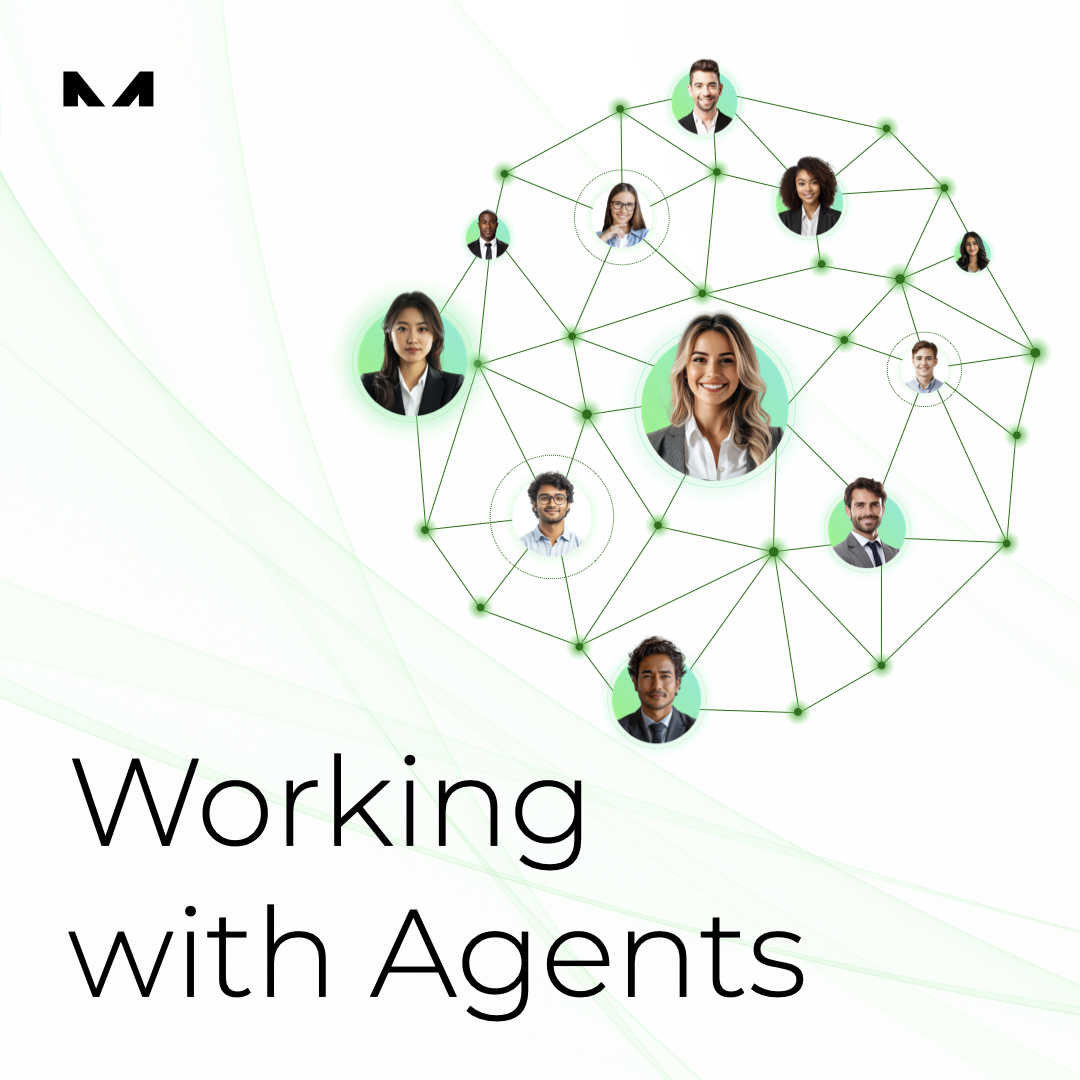
The single-purpose AI agent is already giving way to multi-agent systems, where specialized agents collaborate under central coordination to execute complex workflows.
This architecture matters precisely because of what it does to trust. When every agent has a defined, narrow role, its behavior becomes predictable. When agents hand off between themselves through structured protocols rather than making open-ended decisions, the points of human review become clear. When an orchestration layer sits above all of them, a media leader can see — in one place — what is running, what has been triggered, and where the system is asking for a decision. In a media context, for example, one agent can be responsible for channel allocation, another for planning, a third for campaign optimization, and an orchestration agent should coordinate the whole system.
The gains are immense: a well-designed multi-agent system is easier to audit, easier to override, and easier to explain to a client or a regulator than a single agent making decisions across multiple domains simultaneously.
PwC's AI Agent Survey found that business leaders show significantly greater confidence delegating tasks like data analysis and performance optimization to agents, but trust drops sharply for higher-stakes use cases such as financial transactions, which in media terms maps directly to large budget moves, new partner commitments, or decisions with brand exposure. The implication is not that agents should be kept away from high-stakes decisions, but that those decisions require a different, more deliberate governance design.
That design starts with knowing precisely where human judgment needs to enter the workflow. Humans need to stay in the lead, with clear frameworks defining when and how people step in and remain accountable for outcomes. For marketing and media, that means escalation triggers need to be part of the system's core design: the moments where an agent surfaces a decision rather than takes it, where a planner reviews rather than approves, where a human owns the outcome.
Gartner predicts that 40% of enterprise software will feature task-specific AI agents by the end of 2026. The key pillars of real agentic deployment in established workflows are being
- more precise about what those agents are asked to do,
- more explicit about the boundaries within which they operate, and
- more disciplined about the human review mechanisms that surround high-stakes decisions.
An orchestration platform that treats agent governance as a first-class design principle — not a post-deployment afterthought — is the foundation on which that trust is built. That is the architecture MINT brings to media and marketing teams who are ready to move from agent experimentation to agent confidence.